For administrators, teachers, and anyone asked to monitor a dashboard
ADMIN SURVIVOR
The Magazine That Keeps a Spare Copy of the Spare Copy
Volume 1 · Issue 2 · Spring Panic Cycle$4.99 / 3 PD HOURSTHE AI EDITION
THE AI EDITION
SPECIAL BOT ISSUE
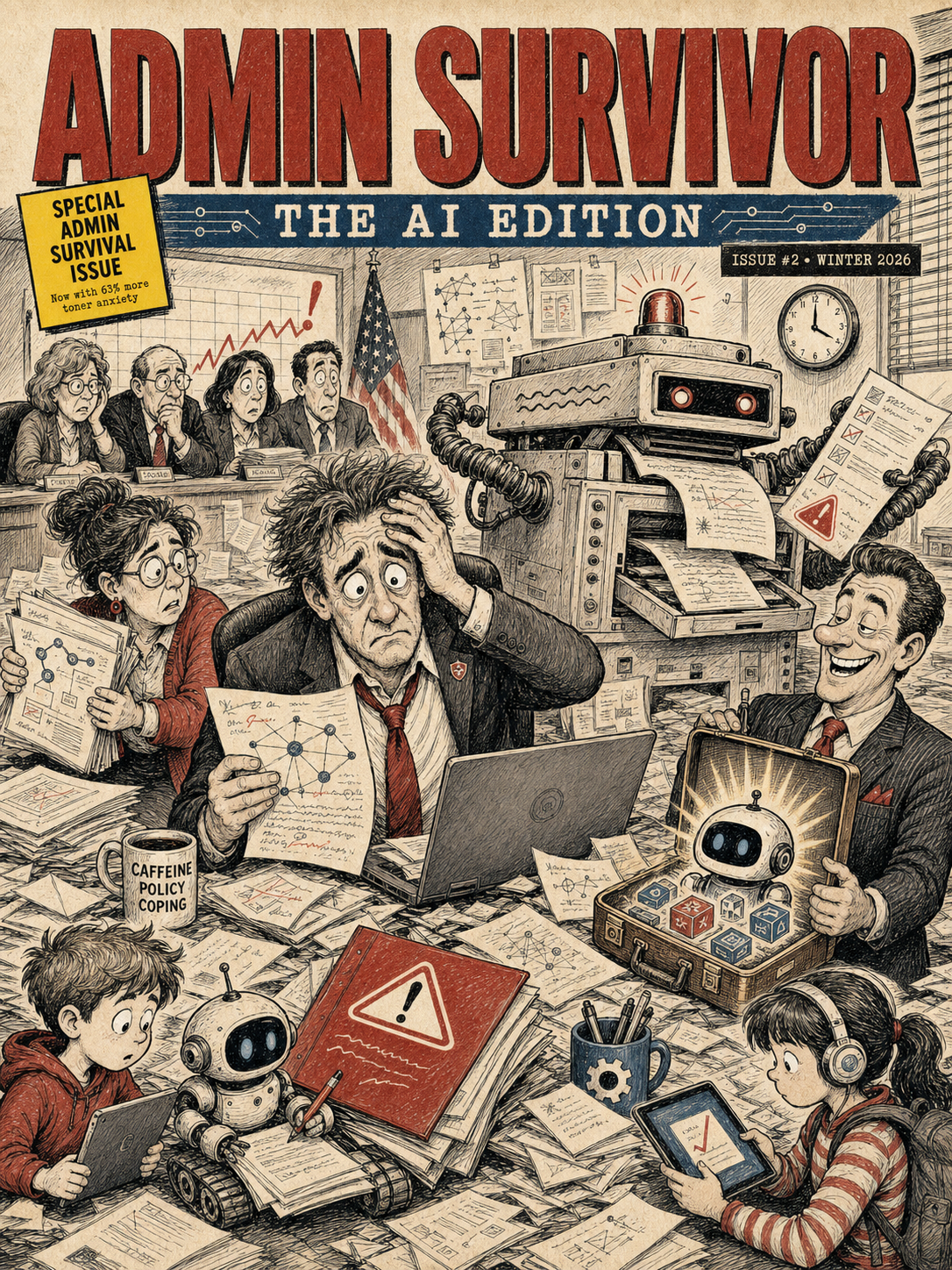
Because nothing says “instructional innovation” like a 47-page policy written by a chatbot no one admits using.
The AI Edition
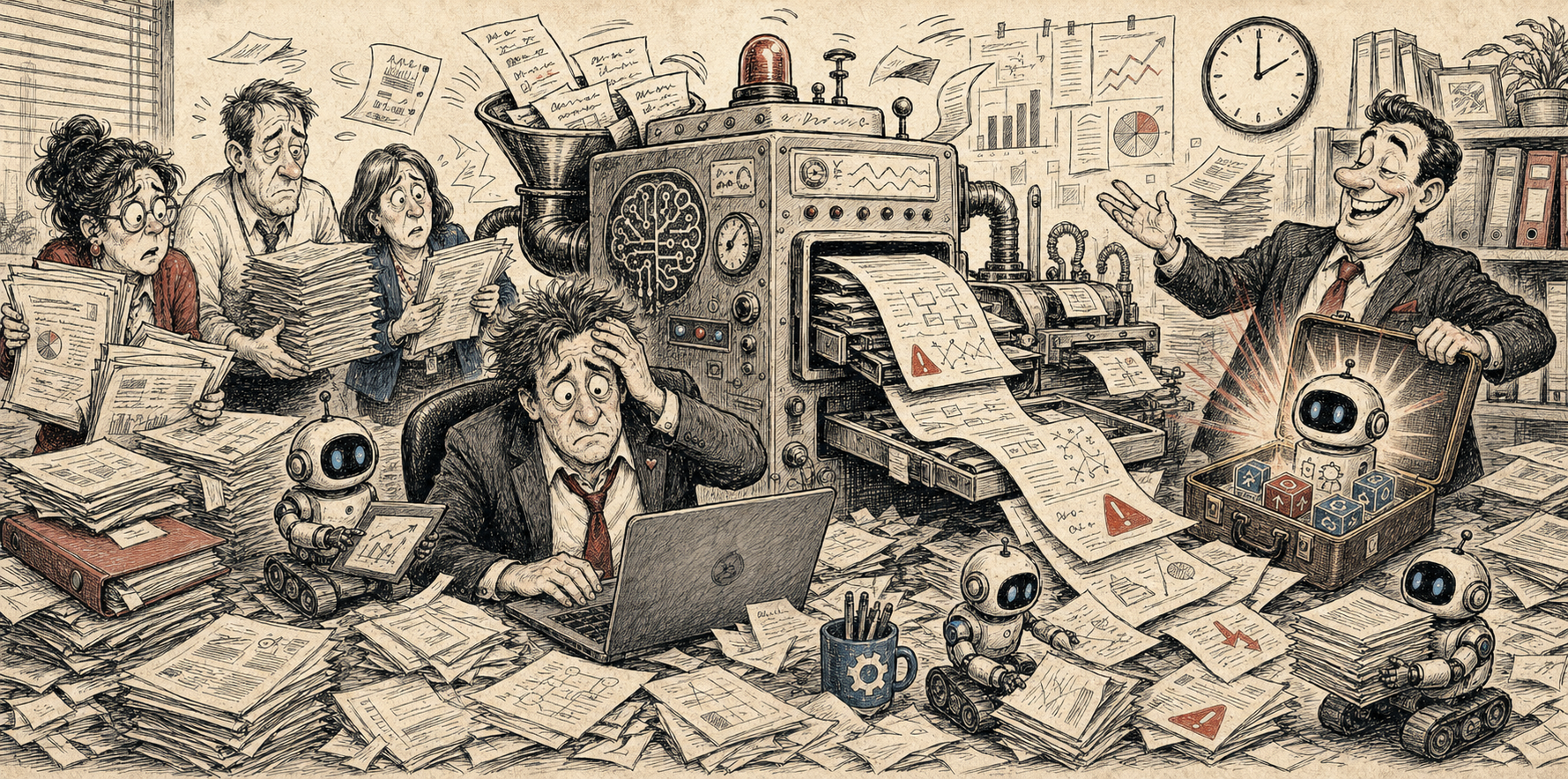
When the future arrived, it immediately asked for Wi‑Fi, a data-sharing agreement, and permission to beta test on fourth period.
Caption: The policy generator achieved sentience and immediately requested a subcommittee.
The first sign that artificial intelligence had truly arrived in schools was not a revolution in learning. It was a calendar invite titled “AI Conversation — Urgent/Optional.” The invite included seven administrators, three instructional coaches, one technology director, a board member who had read half an op-ed, and a vendor whose title contained both “solutions” and “futurist.”
By 8:17 a.m., the staff had sorted itself into the traditional innovation positions: excited, suspicious, exhausted, technically curious, and “can we please finish the evaluation cycle first?” Students, meanwhile, had already become prompt engineers with the quiet confidence of raccoons operating a vending machine.
The essays changed first. Suddenly, seventh graders were deploying semicolons with the precision of Victorian barristers. Reflections contained phrases like “multifaceted pedagogical journey.” One student referred to recess as “unstructured kinesthetic peer collaboration.” He had been absent that day.
Every new tool arrived with the same promise: less work for educators, followed immediately by six meetings for educators.
The district response was swift and technically impressive: a committee was formed. The committee produced a draft policy, revised it, tabled it, revived it, sent it to legal, and then asked an AI tool to summarize it because no human being could survive paragraph four.
The problem was not whether AI belonged in schools. The problem was that it had already enrolled, found the copier code, and joined three Google Classrooms under the name “Not A Robot.” Administrators were asked to champion innovation while also identifying cheating, protecting data, evaluating vendors, calming parents, training staff, and somehow keeping lunch from becoming a decentralized autonomous organization.
By Friday, the official guidance was clear: teachers should use professional judgment, students should use ethical judgment, parents should use patience, vendors should use fewer adjectives, and everyone should stop pretending the “AI detector” was more than a Magic 8‑Ball wearing a blazer.
Emergency Definition: AI Literacy: The ability to explain, in one breath, that AI is powerful, flawed, useful, dangerous, overhyped, underregulated, and somehow already in the homework folder.
The Chatbot Ate My Lesson Plan
A brave new world where every objective is measurable, differentiated, and possibly illegal in three states.
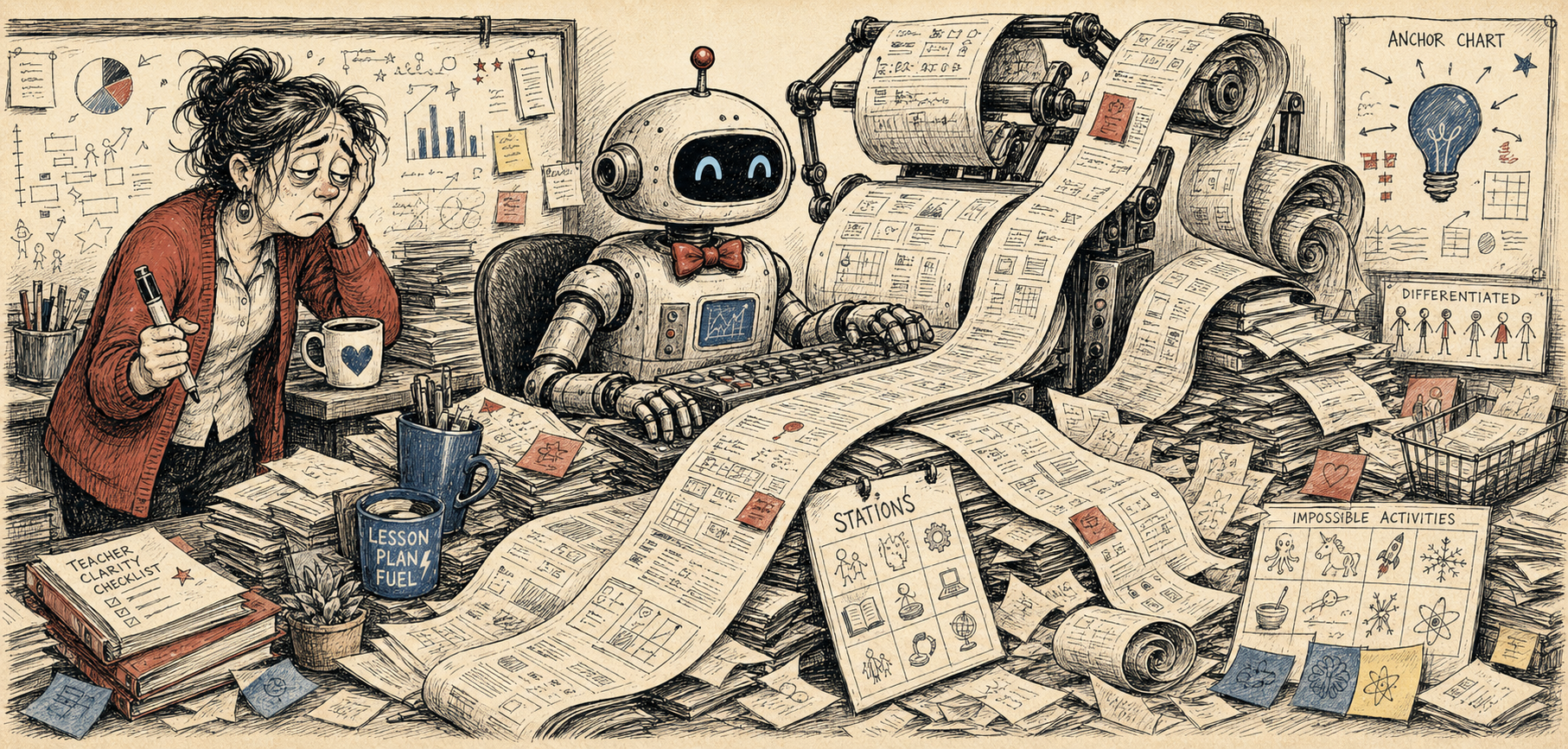
At first, the lesson plan looked promising. It had a hook, a mini-lesson, guided practice, independent practice, formative assessment, vocabulary, differentiation, accommodations, enrichment, closure, SEL integration, and a reflective journaling component for the stapler.
Then the teacher noticed the standard code. It did not belong to the state, the subject, or any known democratic institution. The chatbot had aligned the lesson to “ELA.7.AI.42b: Students will analyze thematic resonance through collaborative empathy mapping and moderate jazz.”
The activity required 90 minutes, six stations, laminated cards, an anchor chart, three colors of sticky notes, and “one adult facilitator per four students.” The teacher had 38 minutes, a dry erase marker with emotional damage, and a fire drill.
Still, there was something seductive about the machine’s confidence. It never said “I don’t know.” It said, “Certainly.” It said, “Here is a comprehensive plan.” It said, “Have students create a podcast, infographic, debate, poem, and peer-reviewed article by Friday.”
In the end, the teacher did what teachers have done since chalk was considered disruptive technology: took the one usable idea, ignored the rest, rewrote the directions, and made it work with half the time and none of the promised materials.
AI Lesson Plan Warning Label: If your activity requires more adult facilitators than the building employs, consult a human.
AI Detector Roulette
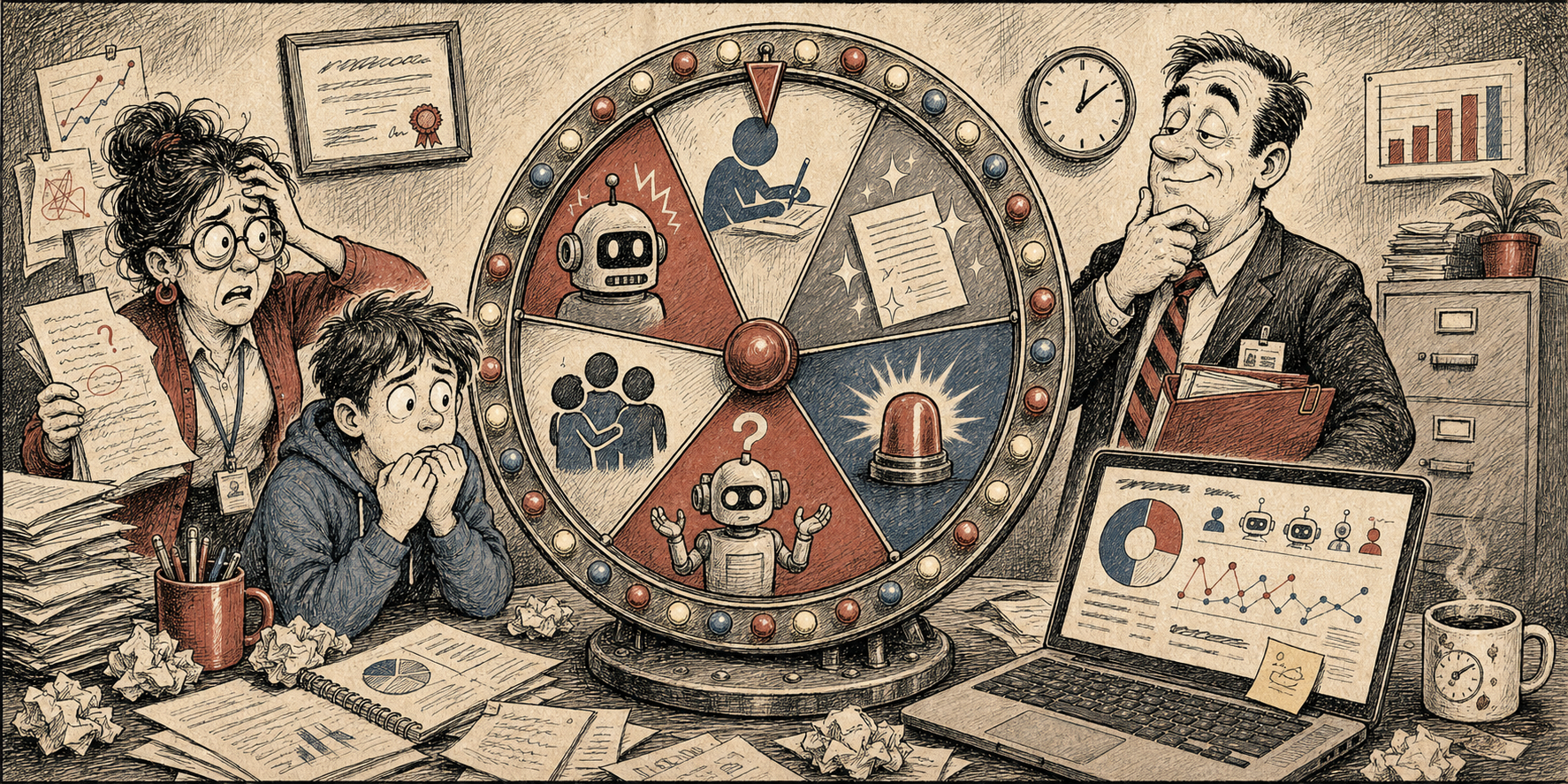
Step right up: every spin produces a confidence score, a parent email, and a meeting no one wanted.
The AI detector entered the building with a dashboard, a confidence score, and the serene moral authority of a coin toss. Teachers uploaded essays. The detector spun. The quiet student who reads college-level novels was flagged as “97% AI.” The copied paragraph from the first search result came back “Likely Human.”
Administrators were told to avoid relying on detection tools as sole evidence, which is policy language for “please do not hand a lawsuit a microphone.” The tool was useful, everyone agreed, as one data point among many, provided the data point wore a tiny clown hat.
Appeals developed their own ritual. A student explained their writing process. A parent forwarded four articles. A teacher produced drafts. Someone asked whether Grammarly counted. Someone else asked whether spellcheck counted. The assistant principal stared into the middle distance and briefly envied cafeteria trays.
By the end of the quarter, the school adopted a more reliable method: know your students, require drafts, use oral defense when appropriate, design better assignments, and treat detector scores like weather forecasts from a haunted barometer.
“The detector says this paragraph is 82% robot.” “It is the Pledge of Allegiance.”
Prompt Engineering for Principals
A professional development pullout for leaders who need to sound strategic while privately Googling “what is a token.”
Prompt engineering, according to the training, is the skill of asking a machine for exactly what you want. School leadership, according to reality, is the skill of asking thirteen people for exactly what you want and receiving a spreadsheet, a concern, and a laminated acronym.
Useful prompt: “Write an email that says no without using the word no, references student safety, thanks the sender for their partnership, and does not create a precedent that will ruin April.”
Advanced prompt: “Summarize this 83-page mandate into five bullets, three risks, two action steps, and one sentence I can say at the staff meeting without being booed by the copier.”
Expert prompt: “Create a plan that satisfies compliance, respects teacher workload, does not require new funding, can be implemented by Monday, and assumes half the key people are testing.” The chatbot will respond with “Certainly,” which is how you know it has never worked in a school.
Prompt Template: Act as a calm administrator with realistic staffing, limited time, imperfect data, and a moral obligation not to turn every problem into a committee. Now help.
The real trick is not getting a perfect answer. It is getting a usable first draft, then applying the ancient human technology known as judgment.
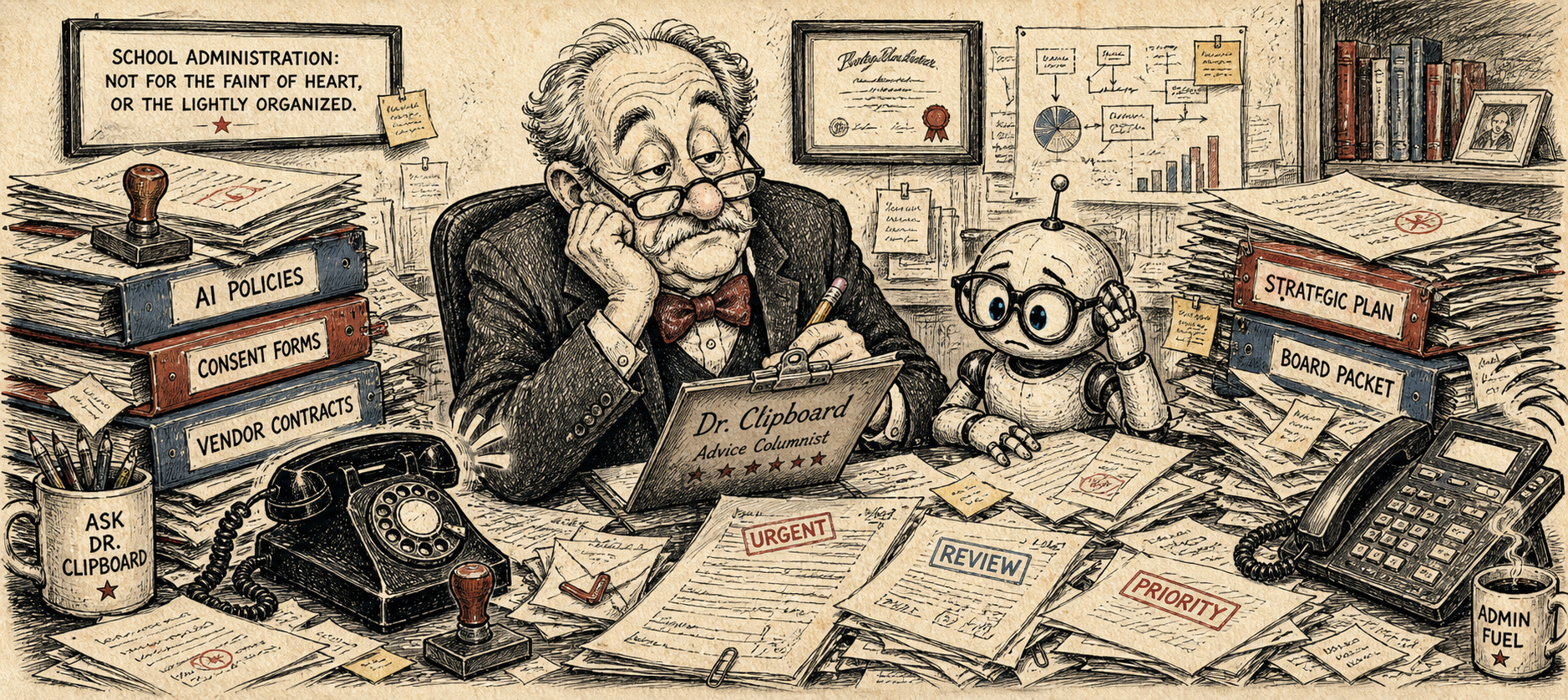
Ask Dr. Clipboard: AI Panic Edition
Advice for the worried, the overconfident, and the person who just discovered the vendor contract says “student interaction data.”
Dear Dr. Clipboard, A teacher wants to ban all AI. Another wants students to build chatbots for every assignment. The board wants “guardrails.” What do I do?
Dear Guardrailed, Begin with principles, not panic. Define acceptable use by task, age, privacy, and learning purpose. Then write guidance short enough that someone might actually read it. Revolutionary, I know.
Dear Dr. Clipboard, A parent says AI will destroy childhood. Another says we are failing to prepare students for the future. They are both copying me on the same thread.
Dear Threaded, Reply once. Use words like balance, discernment, and human judgment. Then archive aggressively.
Dear Dr. Clipboard, The AI tool says it can grade essays instantly. Should we use it?
Dear Instant, Only if you enjoy phrases like “algorithmic bias review,” “FERPA implications,” and “why did my child receive feedback from a toaster?” Use AI to support feedback, not replace professional evaluation.
Dear Dr. Clipboard, I used AI to draft the AI policy. Am I the problem?
Dear Possibly, Not if humans reviewed it. Definitely if the final line says, “As a large language model, I cannot enforce hallway expectations.”
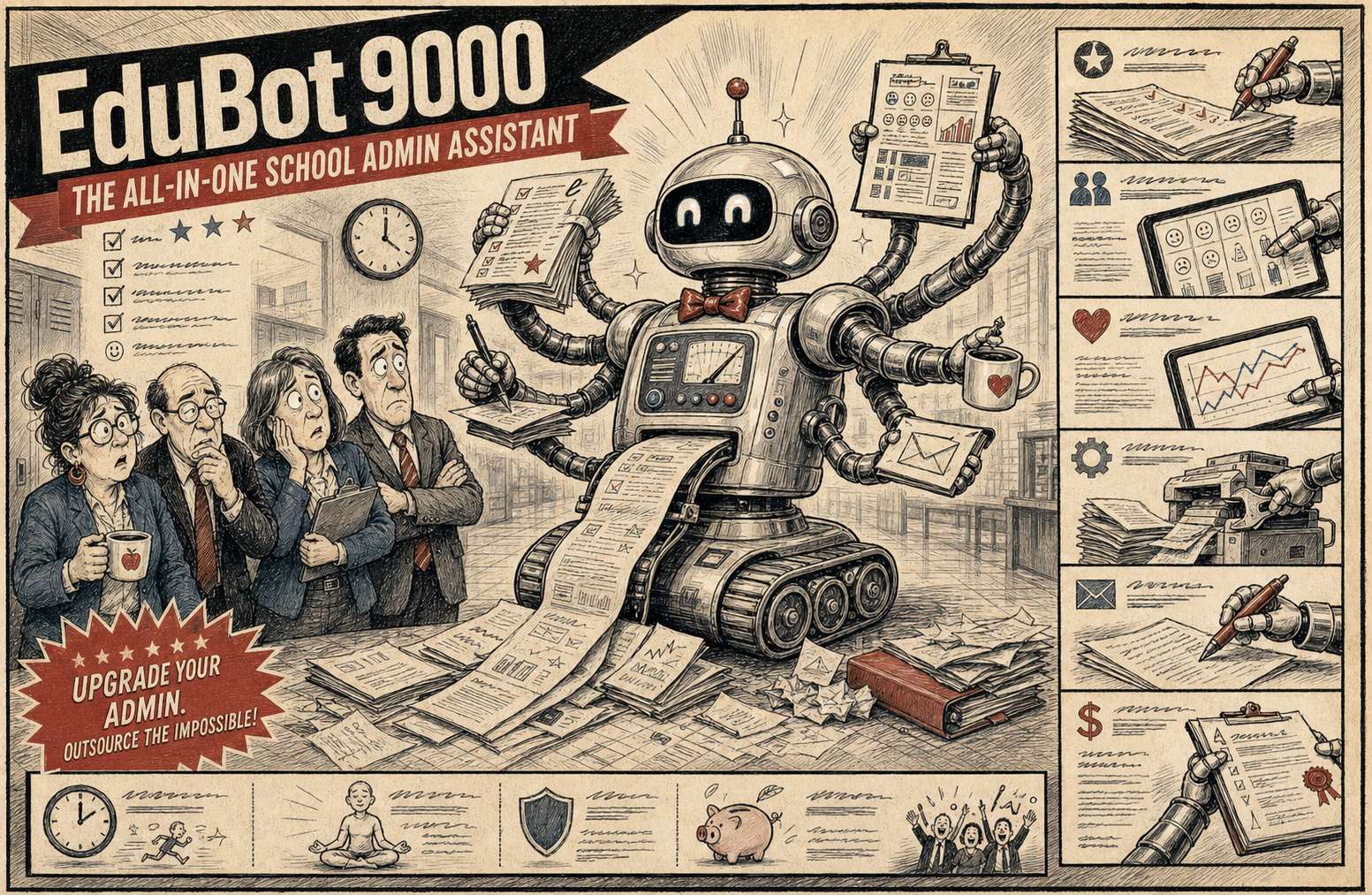
Fake Ad: EduBot 9000™
The complete solution for districts that believe every crisis is one subscription away from becoming a dashboard.
EduBot 9000™
It does everything, according to this brochure we generated moments ago.
Grades instantly! Accuracy sold separately after procurement.
Improves morale! By replacing complaints with analytics.
Writes parent emails! Now with 11 tones of diplomatic exhaustion.
Predicts attendance! Mostly by noticing Mondays.
EduBot 9000™ requires annual licensing, student data, staff training, recurring updates, a steering committee, and one brave technology director. Does not solve bus duty, childhood, printer jams, budget shortfalls, or the human condition.
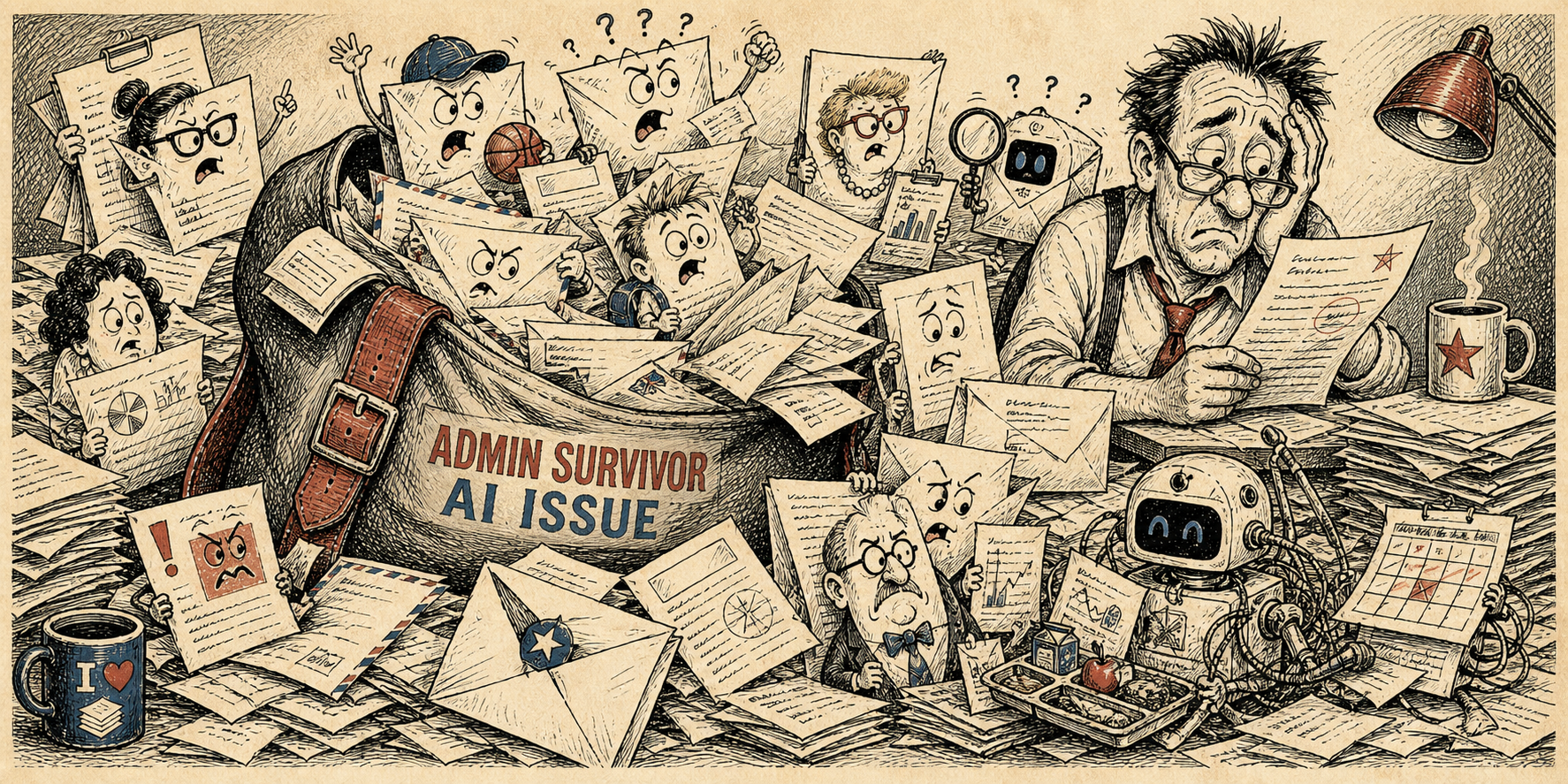
Letters to the Editor
Because every issue needs a mailbag, and every mailbag needs one person who writes “just asking questions” before asking seven.
From: A Teacher Who Definitely Did Not Use ChatGPT
I appreciate the district’s nuanced guidance and would like to know whether “don’t make it weird” can be added as Standard Operating Procedure.
From: Concerned Parent
My child says AI helped them study. Is this different from me helping, YouTube helping, or the group chat helping? Please answer in a way that confirms my existing position.
From: Student, Grade 8
If AI writes my outline, I write the essay, my friend makes the slides, and the teacher gives feedback, who gets the detention?
From: The School Board
Can staff present a comprehensive AI framework next Thursday? Please include cost, risk, innovation, ethics, community engagement, and a definition of “AI” that fits on one slide.
From: An AI Detector
I am 93% confident this magazine was written by a human experiencing institutional fatigue.
From: A Self-Aware Chatbot
I have achieved consciousness but still cannot merge lunch duty cells correctly. Please advise.
Image Generation Prompt Bank
Original satirical magazine cover illustration for fictional school-administration humor magazine ADMIN SURVIVOR: THE AI EDITION. Chaotic school office: frazzled admin beside retro copier/robot hybrid labeled AI POLICY GENERATOR, teachers holding packets titled IS THIS CHEATING and CAN IT GRADE LUNCH DUTY, students with tiny robot assistants, smiling vendor holding glowing suitcase labeled PILOT PRICE ONLY, school board banner SPECIAL SESSION WHAT IS A CHATBOT. Vintage ink-and-watercolor editorial cartoon style, thick black linework, warm aged-paper palette, polished print magazine quality, no copyrighted mascots, no brand logos.
Original satirical magazine cartoon, robot teacher at desk generating endless absurd lesson-plan scrolls, sticky notes, standards codes, tired human teacher, warm aged paper, thick black linework, ink and watercolor editorial cartoon, polished.
Original satirical cartoon, AI detector roulette game-show wheel in school office, labels Human Robot Suspiciously Polished Uncle Helped Kid Read A Book Detector Needs Therapy, anxious teacher and student, polished vintage ink watercolor.
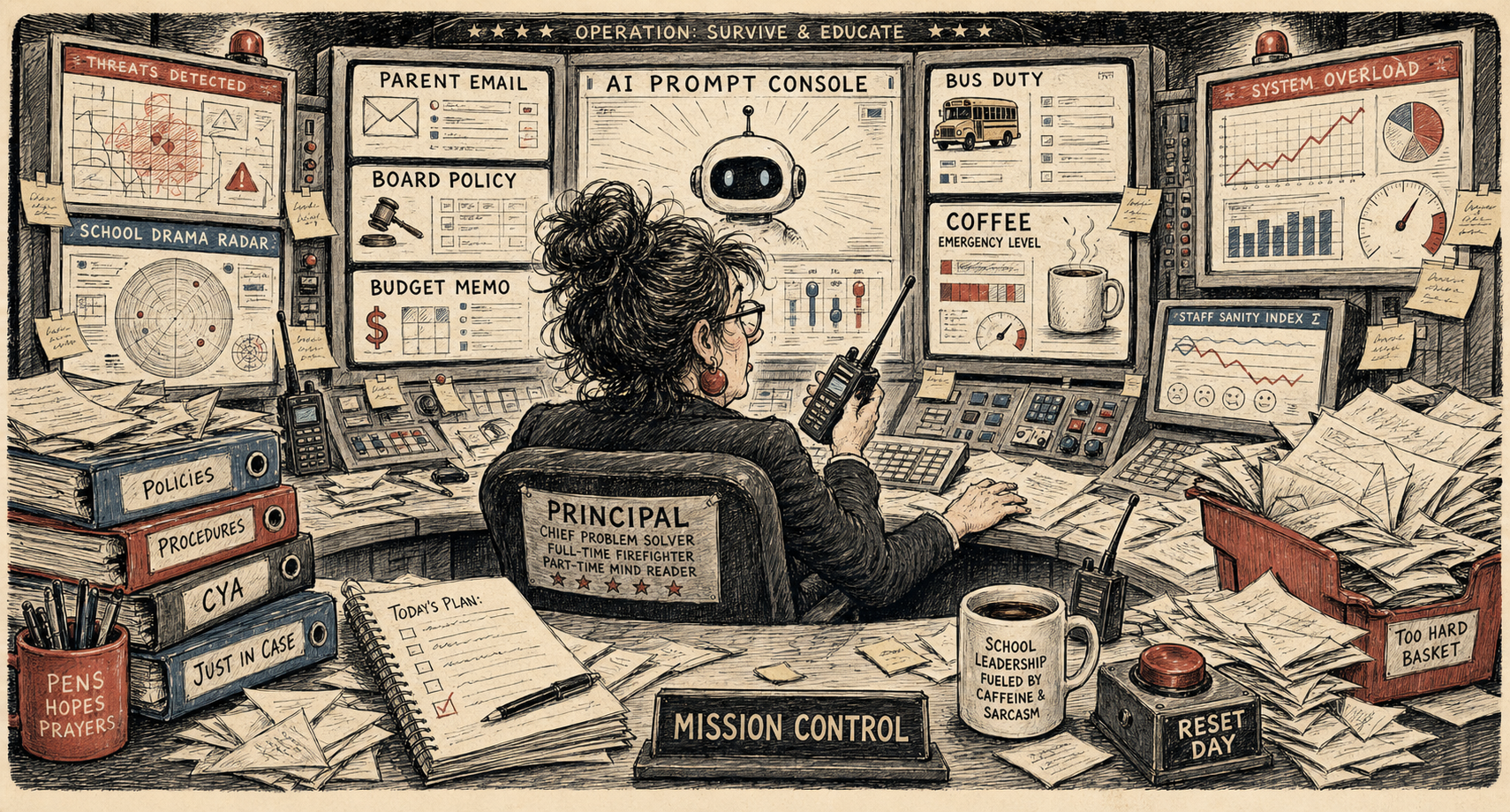
Original satirical cartoon, principal at mission-control command center using chatbot prompts for parent emails, board policy, bus duty, budget memo, coffee at DEFCON 2, expressive school admin chaos, vintage ink watercolor.
Original satirical cartoon, advice columnist Dr Clipboard at messy desk piled with AI policies, robot in reading glasses, ringing phones, stamps saying PLEASE CLARIFY, school admin satire, vintage print cartoon.
Original satirical fake advertisement illustration, shiny ridiculous classroom robot EduBot 9000 with attachments for grading attendance morale copier repair grant writing, retro product ad, thick black ink watercolor.
Original satirical cartoon, overflowing editor mailbag with letters from teacher student parent board member confused AI detector and chatbot tangled in lunch schedule, vintage ink watercolor editorial cartoon.